
Introduction
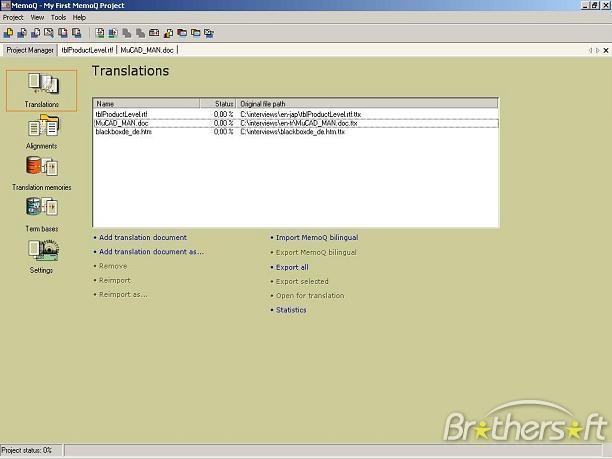
I will take the opportunity in this post to give a brief introduction for another CAT tool, MemoQ, which is a suite of programs that includes a memory server and project management tools. I will return to this tool in future articles to analyze its capabilities in further detail.
Operating Systems
This translation and edition program is compatible with Windows 2000, XP, and Vista.
Resources of the Program

These include:
- translation memory;
- aligner;
- terminology base;
- translation editor, which doubles as a word processor.
Translation Memory
In a style very similar to Trados, which we have already discussed in previous posts, such as TRADOS, What is Trados?, and How to Get Started with Trados, among others, MemoQ respects the format of the original document and loads the translation from the translation memory, where it exists. The segments of the source file are stored in the translation memory with their corresponding translations. Thus, when there is a certain degree of coincidence with a different segment of the original document, the translation memory displays it with the respective percentage of coincidence.
Alignment
In addition to the possibility of creating the content of the translation memory through the translation process, a new memory can be created through the process of alignment. It is then possible to edit the output of the alignment process.
Terminology Base
To create a glossary, we use a terminology base that allows us to load an expression with its translation in more than one language and also make additional comments. These entries in the terminology base appear automatically while you use the word processor and are inserted in the translation through a simple keyboard shortcut.
Level of Productivity
There is a function that analyzes the source document and predicts how much time the translator will save by using the translation memory. The level of productivity for each project is measured by considering the number of repetitions in the document: if it is something with a large number of repetitions, for example a manual, the increase in productivity could reach 70-80%; if there are not many repetitions, then use of the translation memory will only result in an increase of 10-20%. For documents that are entirely new and unique text, there is no gain in productivity.
Your Opinion
We are interested in your opinion on the use and functions of this program. You can leave us your thoughts here in the comments or in this translation forum.
(Spanish version: https://www.trustedtranslations.com/memoq-2010-05-04.html)


